|
|
| Overview |
Throughout this online workshop series, participants will deepen their understanding of what it means to encourage positive ways of being in early childhood settings, moving beyond traditional notions of behaviour management. The series is grounded in a view of children as capable, relational, and having agency, and recognises that behaviour is shaped through relationships, environments, routines, and shared expectations.
Participants will explore how adult beliefs, language, power, and pedagogical choices influence children’s ability to regulate themselves, resolve conflicts, and act with care and respect for themselves, others, and the world around them. Rather than relying on external rewards or punishments, the focus is on supporting children to develop internal motivation, empathy, and responsibility over time.
Across the four sessions, educators are invited to reflect on their role as relational leaders, consider the uniqueness of each child, and examine practical strategies that support emotional regulation, cooperation, and conflict resolution. Reflection prompts and guiding questions accompany each session to support ongoing inquiry and application in participants’ own contexts. |
| |
Session 1: Encouraging Positive Behaviour, Using Your Voice
Explore why the language encouraging positive behaviour reflects a more respectful and intentional stance than behaviour management. Examine how beliefs about children shape adult responses to behaviour. Inquire into power dynamics in adult-child relationships and what it means to “do things with children rather than to children”. Understand why relationships are foundational to positive behaviour. Consider how environments, materials, and engaging learning experiences support children as active learners. Reflect on the power of one-on-one interactions and positive, authentic feedback. Explore how calm, clear, and specific language supports children’s understanding of expectations. Examine the importance of consistency, follow-through, and fairness. Consider how language, gestures, and clarity support multilingual learners. Reflect on negotiation, consultation, and modelling as expressions of respect and leadership. |
|
Session 2: Harnessing the Power of Rhythm, Rituals, and Traditions
Understand why rhythm and predictability are essential in young children’s lives. Explore how routines and advance warnings support smooth transitions. Investigate the role of songs, rhymes, and gestures in creating emotional security. Examine how rituals support emotional regulation during sensitive moments. Distinguish between rituals and traditions and how both contribute to classroom culture and Belonging. Reflect on the importance of consistency over time. |
Session 3: Adjusting Strategies: Each Child Is Unique
Explore the importance of seeing and honouring each child’s individuality. Reflect on how children’s backgrounds and experiences shape behaviour. Understand why patience and time are essential for behavioural growth. Investigate how identifying triggers supports more responsive strategies. Explore coping tools such as storytelling, breathing, movement, outdoor time, and calming Spaces. Reflect on how adults can support children in finding strategies that work for them. |
Session 4: Supporting Conflict Resolution Among Children
Move beyond supervision toward being present with children during conflict. Explore how conflict supports the development of empathy, perspective-taking, and resilience.
Learn a shared, step-by-step approach to conflict resolution:
- Acknowledge feelings
- Gather information
- Restate the problem
- Ask for solutions
- Choose a solution together
Reflect on the importance of follow-up support. Consider how guided practice helps children gradually resolve conflicts independently. |
| Workshop Objectives: |
Participants will:
- Develop a shared understanding of encouraging positive behaviour as a relational and pedagogical process.
- Examine how adult beliefs, language, and power influence children’s behaviour.
- Deepen understanding of how routines, rituals, environments, and relationships support self-regulation.
- Explore practical strategies for supporting individual children’s emotional and behavioural needs.
- Strengthen approaches to conflict resolution that nurture empathy, autonomy, and collaboration.
|
| Resources: |
| Guiding questions and reflective prompts accompany each session to support educators in
connecting ideas to their own practice and context. |
| Potential Audience: |
| This workshop series is best suited for early childhood educators, teaching assistants, and school leaders working with young children who wish to deepen their understanding of positive behaviour as a relational and rights-respecting practice. |
|
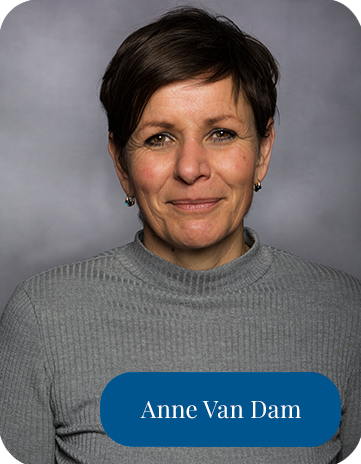
| About Anne Van Dam |
Anne Van Dam is an experienced educator and educational consultant who is deeply passionate about the role of play in children's learning process. She believes in the power of documentation as a tool for educators to reflect on and grow in their practice by exploring the various threads, ideas, and connections that underpin children's investigations.
Throughout her career, Anne has held various roles in the field of education, including teacher, curriculum coordinator, head of school, and vice-principal. Her international experience includes working in schools located in China, Singapore, Switzerland, and The Netherlands.
Anne's passion for education and dedication to empowering educators and young learners led her to collaborate with the International Baccalaureate (IB) regional office in The Hague, where she worked with the PYP (Primary Years Programme) development team on the IB PYP review. Her focus areas during this collaboration included learner agency, early years education, inquiry-based learning, and aspects of creating a strong learning community.
Since 2015, Anne has been working as an independent educational consultant. Her primary goal is to support schools and educators in developing a shared pedagogy that recognizes and honors young children as incredible learners and meaning makers. |
|
| Dates & Timings |
January 9th, 16th, 23rd & 30th, 2027
Each Session is for 2 Hours
London 7:00 am | Zurich 8:00 am | Dubai 11:00 am | India 12:30 pm
Hong Kong 3:00 pm | Melbourne 6:00 pm
This workshop will be not recorded
Please click here to check your time for the workshop |
| Investment |
USD 500
Includes: Certificate of Participation for 10 Professional Development Hours. |
 |
|
|
| Upcoming Workshops |
 |
| Humanizing Education in the Face of AI: The HUMANE Leader's Guide to Reclaiming Humanity in Schools |
| What is the purpose of education? What does it mean to be human in a world of Artificial Intelligence? And what happens to educators, and to students, when schools treat people as data points rather than human beings? |
 October 14th, 21st, 28th & November 4th, 2026 October 14th, 21st, 28th & November 4th, 2026 |
 USD 400 Closing Date 10th October 2026 USD 400 Closing Date 10th October 2026 |
|
 |
|
|
| |
| |
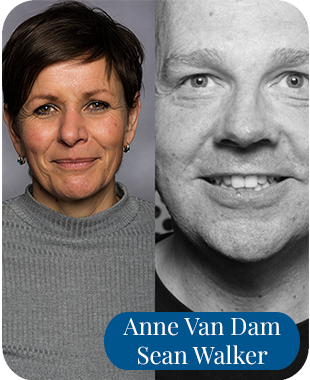 |
| Journey Through a Day in Kindergarten: Nurturing a Culture of Inquiry |
| Throughout this online workshop, participants will have an opportunity to experience a day in the life of a Kindergarten class (children turning six this academic year) at the International School of Paris. |
| October 31st, November 7th, 14th & 21st, 2026 |
| USD 500 |
|
|
|
|
| |
| |
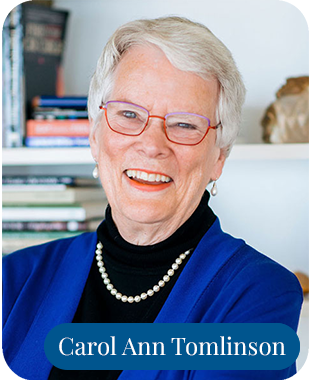 |
| The Role of Formative Assessment in Differentiation |
| While there is a great deal of conversation in schools about formative assessment, it is relatively rare to see it implemented in classrooms in ways that reflect its intent or its potential to be a game changer for teaching and learning. |
| November 10th, 17th, 24th & December 1st, 2026 |
| USD 500 Closing Date 1st November 2026 |
|
|
|
|
| |
| |
| |
|
|
|
|