|
|
| Overview |
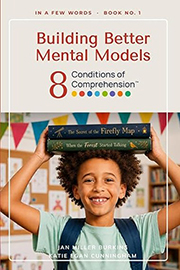 Eight conditions have to hold at once for a reader to build a mental model and comprehend a text. Over three days, we will take up all eight conditions required for comprehension. We will explore what they are, how to teach them, and how to know if our comprehension instruction is working. Eight conditions have to hold at once for a reader to build a mental model and comprehend a text. Over three days, we will take up all eight conditions required for comprehension. We will explore what they are, how to teach them, and how to know if our comprehension instruction is working.
They can read the words, but they don’t comprehend.
Every word on the page comes out correctly. Then the book closes and nothing sticks. In first grade, nobody worries because the decoding is the emphasis and it’s on schedule. By third grade, comprehension starts to surface as a problem, but no one really knows what to do about it. By fifth grade, the reader has decided that reading is not for them.
 Comprehension is not a strategy you assign, and it is not a skill you drill during the week and test on Friday. Comprehension is what happens when eight different conditions are met simultaneously and automatically. This integration happens quickly enough that the reader never feels the effort. Loosen any one of the eight conditions, and the mental model the reader is building starts to come apart, and comprehension falls apart along with it. Comprehension is not a strategy you assign, and it is not a skill you drill during the week and test on Friday. Comprehension is what happens when eight different conditions are met simultaneously and automatically. This integration happens quickly enough that the reader never feels the effort. Loosen any one of the eight conditions, and the mental model the reader is building starts to come apart, and comprehension falls apart along with it.
This institute spends three days with all eight conditions. |
| |
| THE SPINE OF THE INSTITUTE; The eight conditions for comprehension: |
The eight conditions are not a sequence, so the numbers below are an index and not an order. All eight conditions run at the same time, and the reader needs every one of them. Everything across the three days connects back to these eight conditions.
1 - Fluency
EFFORTLESS WORD READING
Whatever attention a reader spends sounding out a word is attention taken away from understanding it.
2 - Coherence
IDEAS THAT HANG TOGETHER
Holding a string of sentences together is the text’s job, not only the reader’s.
3 - Verbal Reasoning
READING BETWEEN THE LINES
A text tells the reader just enough and never everything, and what it leaves out is where the reader comes in.
4 - Knowledge
BACKGROUND KNOWLEDGE
Knowledge is the soil a mental model grows in, not a reward for reading well.
5 - Sentences
LANGUAGE STRUCTURES
Sentence structure quietly tells the mind what to hold, what to connect, and what to keep waiting for.
6 - Vocabulary
A WEB OF WORDS
A word is not a definition but a node in a web of meaning, and knowing one deeply opens words the reader has never met.
7 - Motivation
LEANING IN
Comprehension is effortful, and effort follows motivation, so a reader with a real reason to keep going pushes through the hard patches.
8 - Attention
STAYING WITH IT
The mind has a single spotlight, and something has to hold all of this in view at once.
The eight conditions are adapted from Scarborough’s reading rope (2001) and extended with the executive function and bridging processes described in Duke and Cartwright’s Active View of Reading (2021). |
|
| |
| Agenda: |
The Comprehension Institute’s Structure
Three days, three questions, the same eight conditions.
Day 1 - 26th February 2027
What is comprehension?
We begin by rebuilding the definition. Comprehension is not recall, and it is not a set of strategies laid over the top of a text. Comprehension is a mental model, a picture the reader constructs and revises line by line. On day one, you’ll build the understandings that frame the rest of the institute, and you’ll meet all eight conditions inside interactive exercises that bring the conditions to life.
Day 2 - 27th February 2027
How should we teach reading comprehension?
Naming the eight conditions is not the same as teaching them. Day two moves through the conditions one at a time and asks what each one looks like in intentional instruction. You leave with routines and instructional moves you can use on Monday, and with a clear sense of how to strengthen mental modeling in your classroom.
Day 3 - 28th February 2027
How can we best assess comprehension?
Comprehension is the hardest thing in literacy to measure, which is why so much of what gets called comprehension assessment is measuring something else. Day three sorts out what some widely used measures actually reveal about a reader. You leave with formative ways to assess the eight conditions in action in a child’s reading.
This institute is for you if:
- You have watched a child read the words on a page flawlessly while taking little or no meaning from the text.
- Your phonics data looks strong, but you are at a loss about how to support comprehension well.
- You know comprehension instruction involves more than vocabulary and knowledge building.
- You know comprehension assessment needs more than a fluency assessment.
- Your students don’t seem to get more than the gist of a text, if that.
- Your students see comprehension as schoolwork, rather than an active, ongoing process.
- You have been told to teach comprehension without ever being told what comprehension is.
- You are finished arguing about the reading wars, and you want to know what to do next for your students.
- You lead a team, and you need one shared language for comprehension across kindergarten through fifth grade.
This institute is probably not for you if you are looking for a scripted comprehension program, a list of strategies to hang on your classroom wall, or an easy answer to comprehension’s complexity.
What you’ll take home from the Comprehension Institute:
- A definition of comprehension you can explain to a parent, a colleague, or a board.
- Instructional routines that support all eight conditions.
- A broader and more informative approach to assessing reading comprehension.
- Your own copy of Building Better Mental Models.
- A certificate for 24 professional development hours.
|
| |
| Potential Audience: |
| K–5 classroom teachers, interventionists, literacy coaches, reading specialists, and school leaders. Educators at any point in their science of reading work are welcome. |
|
| |
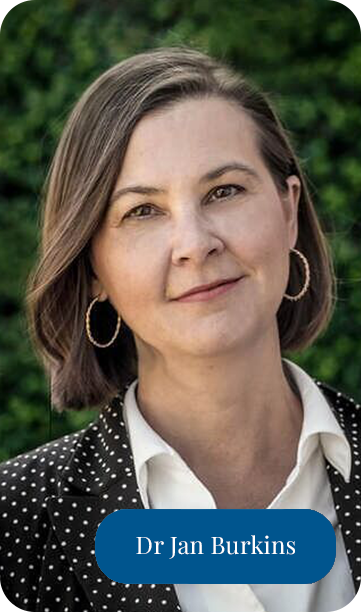
| About Jan Burkins |
Jan began as a classroom teacher and went on to serve as a literacy coach, a district literacy leader, and a regional literacy consultant for the state of Georgia. Today she works with schools across the United States and internationally.
She earned her doctorate at the University of Kansas, where her dissertation, a meta-analysis of the research on phonemic awareness, was named the School of Education’s Dissertation of the Year and was a national finalist for the International Literacy Association’s outstanding dissertation award.
Jan is the author and co-author of more than ten books for educators, including the bestselling Shifting the Balance series, written with Kari Yates and Katie Egan Cunningham. She is also a co- founder of TheSixShifts.com, a professional learning community for educators. Her work holds a steady middle: rigorous about the research, honest about what it does and does not settle for teachers, and practical about how to translate it all into classroom practices that make literacy more accessible.
LEARN MORE ABOUT JAN’S CURRENT WORK AT LITERACYHEART.COM → https://literacyheart.com/ |
|
 |
| Venue: |
International School of Beijing
10 An Hua Street, Shunyi District, Beijing 101318
People's Republic of China
中国北京市顺义区安华街10号, 邮编:101318 |
| |
| Timings: |
8.30 am to 3.30 pm
Registration at 8.00 am on 26th February 2027 |
| |
 |
|
|
| Investment |
USD 1100 Closing Date 15th February 2027
USD 1050 Early Bird Offer Till 1st December 2026
USD 1000 Early Bird offer Till 1st October 2026 |
| |
 Book INCLUDED WITH REGISTRATION Book INCLUDED WITH REGISTRATION
Building Better Mental Models: 8 Conditions of Comprehension
Every participant receives a copy of the little book on which the institute is based, written by Jan Miller Burkins and Katie Egan Cunningham. It is pocket-sized on purpose, designed for reading, discussion, and rereading.
https://literacyheart.com/ |
| |
| Includes: Certificate of Participation for 24 Professional Development Hours. |
|
|
| Upcoming Workshops |
 |
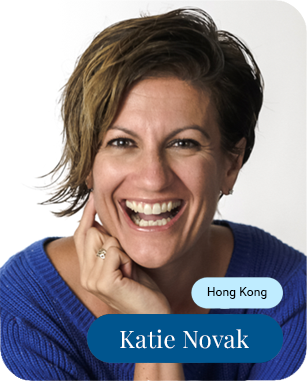
| Teaching Learners with English as an Additional Language |
| Teachers in today’s classrooms are increasingly working with students who are learning through English as an Additional Language (EAL). |
 November 7th & 8th, 2026 November 7th & 8th, 2026 |
 Hong Kong Academy Hong Kong Academy |
 USD 800 Closing Date 1st November 2026 USD 800 Closing Date 1st November 2026 |
|
 |
|
|
| |
| |
 |
| Unlocking Learning for All: UDL & Tier 1 for Inclusive Classrooms |
| This dynamic workshop empowers educators to create truly inclusive learning environments where all students thrive. |
| March 6th & 7th, 2027 |
| Hong Kong Academy |
| USD 750 Early Bird Offer Till 1st November 2026 |
|
|
|
|
| |
| |
 |
| Making the Most of the Power of Inquiry |
| To celebrate the release of the second edition of Kath Murdoch’s treasured book ‘The Power of Inquiry”, Chapters International is hosting a weekend workshop designed to support teachers in strengthening their understanding and application of inquiry. |
| March 13th & 14th, 2027 |
| Wellington College International Shanghai |
| USD 750 Early Bird offer Till 1st November 2026 |
|
|
|
|
| |
| |
| |
|
|
|
|